
Table of Contents
Why Hallways Deserve More Attention
The hallway is the first and last space you experience in your home — the room that sets the tone for everything beyond it. And yet it’s routinely the most neglected space in any renovation budget. Paint is applied, a coat hook is installed, and the design conversation moves on to more “important” rooms.
Wood paneling changes this. Even a modest hallway with well-chosen wall panels becomes a space that signals quality and care throughout the whole home. It’s also one of the most practical panel installations you can do: hallways are high-traffic areas where paint marks and scuffs accumulate rapidly, and a paneled wall is far more durable and easier to maintain than painted plaster.
The Unique Challenges of Hallway Paneling
Narrow Width
Most hallways are 90–120cm wide. In this space, large-format panels can feel overwhelming and installation access is tight. Work with the proportions: vertical slat panels elongate a narrow hallway visually; horizontal treatments (shiplap, board-and-batten) can make it feel even narrower. When in doubt, go vertical.
High Traffic and Impact
Hallways take more physical abuse than any other room — doors opening, bags brushing walls, children and pets passing through at speed. Choose panels with a hard, sealed surface finish that wipes clean easily. Real wood veneer with a lacquered or hard-oil finish is significantly more durable than paint in this context.
Often No Natural Light
Many hallways, particularly internal ones, have no windows. This means species and finish choice matters: very dark panels (ebonised or deep walnut) can make an already dim hallway feel cave-like. Opt for light oak, ash, or a mid-tone with plenty of artificial lighting to compensate.
Multiple Interruptions
Hallway walls are riddled with doors, light switches, sockets, coat hooks, and radiators — all of which require precise panel cutting. Factor in additional time and material for all the notching and fitting required compared to an open feature wall.
Best Panel Styles for Hallways
Wainscoting (Chair Rail Height)
The most practical hallway panel choice. Wainscoting at 90–100cm protects the lower wall from the traffic that damages it most — bags, bike handlebars, children’s hands — while keeping the upper wall lighter. Our wainscoting ideas guide has the full range of style options and material details.
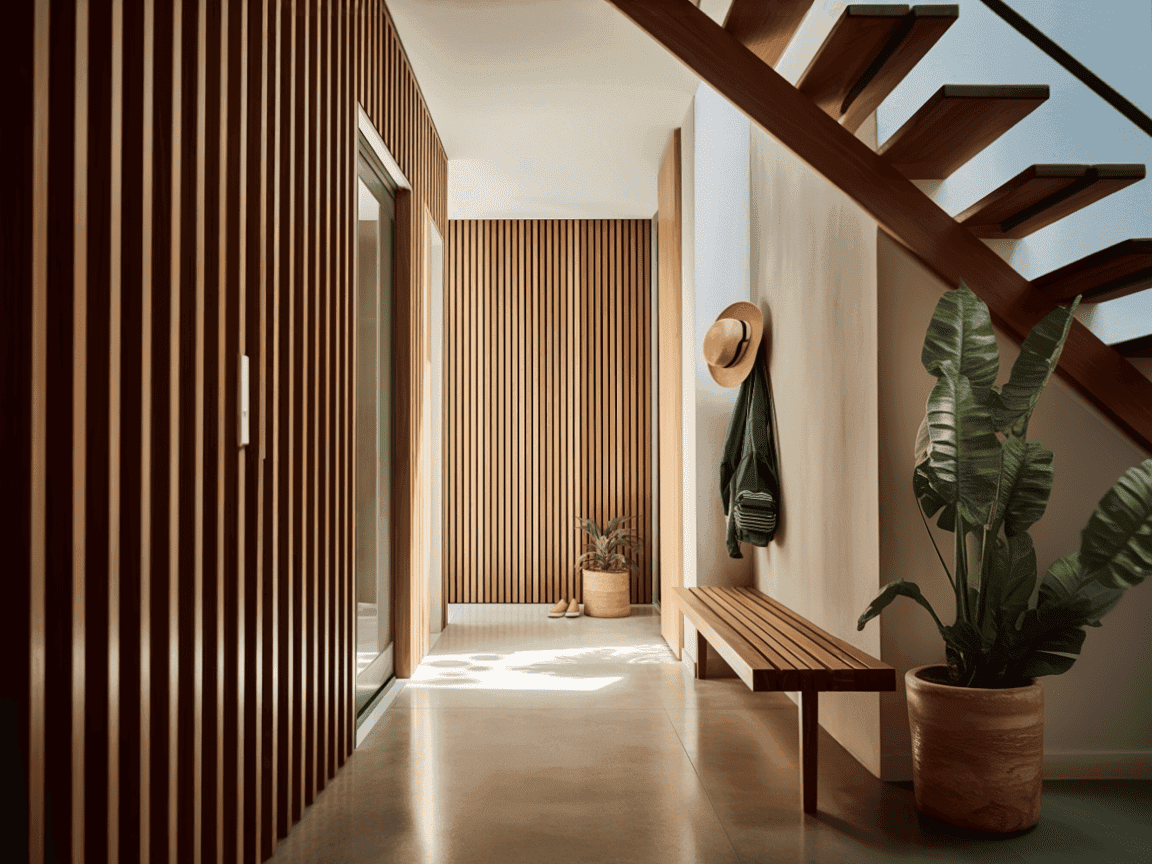
Full-Height Slat Panels on the End Wall
If the hallway terminates in a wall (rather than opening into a room), treat that end wall with floor-to-ceiling acoustic slat panels. It creates a focal point that draws the eye down the corridor and makes the hallway feel designed rather than merely functional.
Board and Batten
Full-height board-and-batten paneling on both hallway walls creates a cohesive, architectural look that suits traditional and transitional homes. More graphic and bold than wainscoting; works particularly well in entrance halls with enough width to carry the visual weight.
Fluted Panels on One Side
In a hallway wide enough to treat one wall as a feature, fluted panels on the longer wall create a hotel-corridor quality that makes a utilitarian space feel considered. Keep the opposite wall plain to avoid closing the space in further.
Colour and Finish Strategy
- Light oak or ash: Best for dark hallways with no natural light — maximises the warmth of wood without adding visual weight
- Painted MDF panels in a warm off-white: Budget-friendly, practical, and timeless — particularly effective with brass hardware
- Mid-tone walnut: Suitable for hallways with good artificial light and enough width to carry a darker material
For a broader view of panel options across the home, our accent wall ideas guide and the wood panel wall complete guide are both worth reading before committing to a style.
Shop Hallway Wall Panels
Browse the full wood wall panel collection at The Panel Hub — the SoundPanel™ acoustic slat range is a popular choice for hallway feature walls and end-wall treatments. Vertical slat panels are particularly effective in narrow hallways: the lines draw the eye upward and elongate the perceived height of the space. For further hallway and entrance design inspiration, our interior slat wall ideas guide covers corridor and entrance applications. The acoustic panel buyer’s guide covers panel construction and specifications in detail.
How to Install Wood Paneling in a Hallway: Key Considerations
Hallway installations present specific technical challenges compared to living rooms or bedrooms. The main issue is depth: most hallways have limited wall space between doors, light switches, sockets, and other interruptions. Before ordering panels, map every obstruction on the wall with masking tape — you will almost certainly need to cut panels around these features, and the more precisely you plan, the cleaner the result.
In narrow hallways, avoid leaving thin slivers of panel at corners or doorframes. Work the panel layout from the most visible centre point of the hall and calculate outward, adjusting the starting offset so that any cut panels at the edges are roughly equal in width on both sides.
Panel adhesive is sufficient for most hallway applications, but in high-traffic areas near the door — where bags are dropped, children run, and wall contact is frequent — supplementary fixings along the top and bottom edges add insurance against impact-related delamination. Small panel pins filled and painted over are invisible on a finished installation.
Finally, consider sealant at floor and ceiling joints. Hallways experience more humidity variation than interior rooms — cold air from an opening door, warmth from radiators — and this cycling can cause gaps at panel edges over time. A flexible, paintable sealant at both joints takes five minutes to apply and prevents the most common long-term maintenance issue.
Wood Paneling for Hallways FAQs
What type of wood paneling works best in a hallway?
Tongue-and-groove, shiplap, and vertical slat panels are all highly suited to hallways. Vertical profiles are preferred because they elongate the wall visually. For paneling that extends to dado height only, MDF-based systems with a painted finish offer excellent durability and are easier to touch up when scuffed than real wood.
How high should dado rail paneling be in a hallway?
Standard dado height is 90–100 cm — approximately the height of a door handle. In hallways with standard 2.4 m ceilings, dado paneling at this height divides the wall in a visually balanced way. In hallways with lower ceilings, a lower dado (75–80 cm) can actually make the room feel taller by increasing the amount of visible upper wall.
Can I panel a hallway with real wood if it gets damp?
Most hallways are fine for real wood panels, as they do not have direct water exposure. However, if the hallway has an external door that opens to rain or significant cold air ingress, apply a sealing finish to the panels and ensure the wall behind is dry before installation. Engineered wood or MDF-core panels are more resistant to moisture cycling than solid wood.
How do I clean wood-paneled hallway walls?
Wipe down with a barely damp microfibre cloth for regular cleaning. For marks and scuffs, a mild soap solution works on most sealed finishes. Avoid abrasive cleaners, which damage the surface finish. Lacquered panels are the easiest to maintain in high-traffic areas like hallways because the lacquer resists fingerprints and surface marks better than oil or wax finishes.